



-
 Noémi Vizi
- Photos: Soós Bertalan
- Reading time: 5 minutes

Majk Hermitage – where silence and noise meet
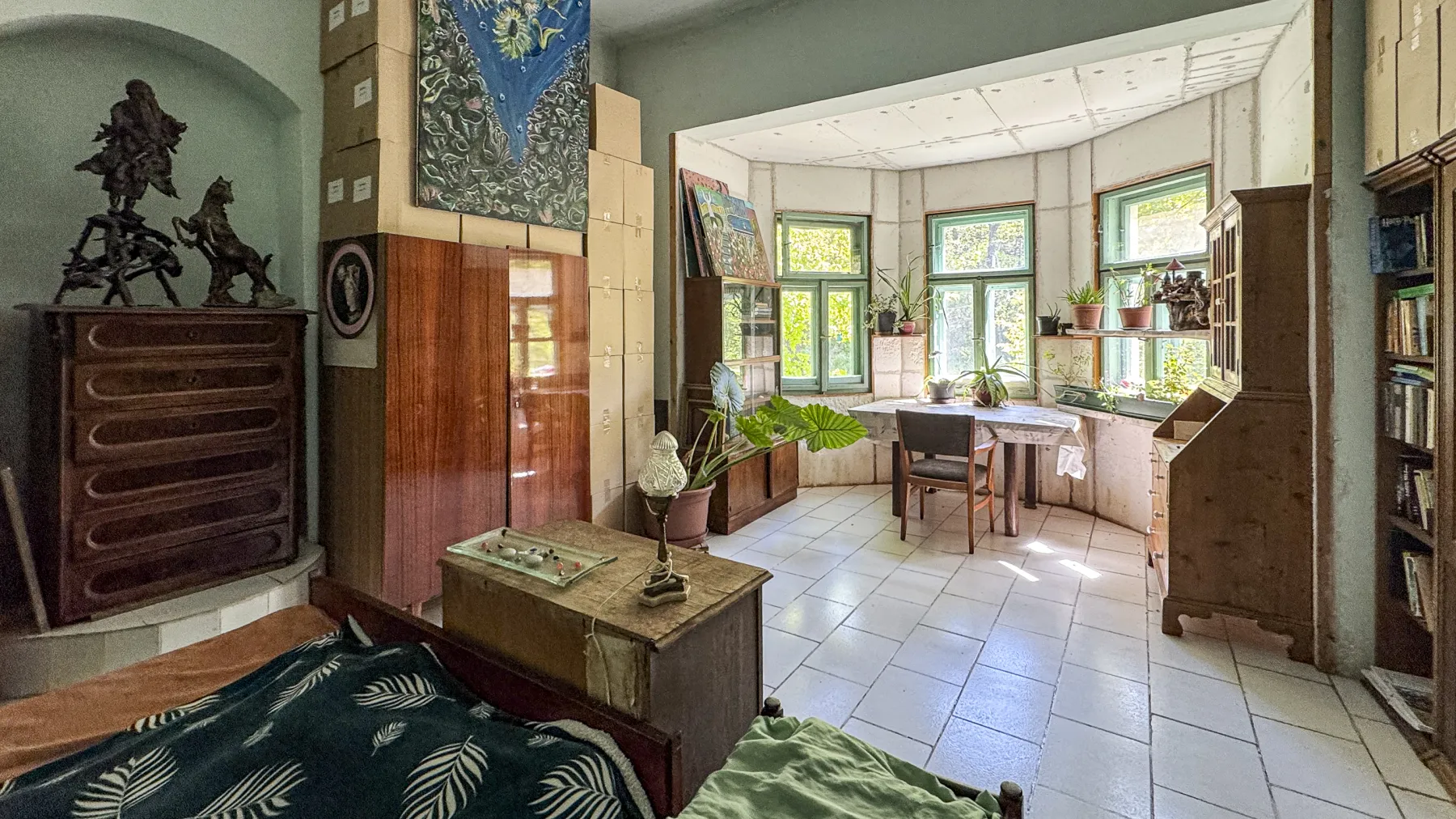
In cell house No. 6, it is 3:30 in the morning, and the inhabitant of the enclosure is waking up, because at 4:00 a.m. he begins his prayers1 in his own private chapel. He prays for himself and for others as well, sometimes for up to eight hours a day. His living quarters consist of an entrance hall, a living room, a chapel, a workshop and a woodshed. When he takes a break, he tends his garden enclosed by high walls that ensure solitude, cooks, carves, or carries out repair work for the other sixteen hermits; in his free time he reads and writes. They live as hermits and have taken a vow of silence. The superiors allowed verbal communication only twice a year, for three days on each occasion2. Prayer was the only exception to the rule of silence.
This description of the daily life of the Majk hermits reflects the period between 1736 and 1782. If we look back at the origins of the order, we must travel back in time to the 11th century. Saint Romuald was born into a ducal family in Ravenna, Italy. As a young man, he enjoyed attending balls, participating in hunts and living the carefree life typical of someone in his twenties. However, he witnessed his father killing one of their relatives in a duel3. This experience completely changed his view of life, and he withdrew to a Benedictine monastery to do penance. For decades he struggled to find inner peace, but in his old age he had a vision. Monks dressed in white appeared before him, climbing a ladder towards heaven. According to legend, this inspired him to establish the Camaldolese Order. The monks were characterised by their white robes, shaved heads and long beards. After three years of study, they were ordained as priests and took a lifelong vow of silence.


In 1733, József Esterházy offered his estates around Majk, including a 1,200-acre wilderness area, lakes and mills, for the establishment of the hermitage. He commissioned Franz Anton Pilgram, a renowned Austrian architect representing the Baroque style, to design the complex. Originally, he planned twenty cell houses, but only seventeen were ultimately built. The foundation stone was laid in 1753, and a fish was placed beside it as a symbol of silence. The construction was financed by donations from Hungarian aristocratic families, commemorated by the family coats of arms placed on the main façades of the houses4. Between 1745 and 1752, the Foresteria was built, housing guest rooms as well as communal areas for the monks, such as the kitchen, library and barber’s room. Between 1753 and 1770, the church was constructed, where the hermits celebrated Mass together. The church tower offers a magnificent view of the surrounding landscape and the Vértes Mountains.
In 1782, Emperor Joseph II dissolved most religious orders operating within the borders of the empire and the kingdom, and the Camaldolese Order was among those affected5. At that time, eleven ordained fathers (priests) and four brothers lived in the hermitage. Some remained in Hungary, while others moved to Italy. By 1784, the estate had become completely empty, with only the mill workers remaining. In 1806, Károly Esterházy purchased the property and leased it to a cloth factory. From the 1860s onwards, the Esterházy family used the buildings as a hunting lodge. After the Second World War, the complex served as a hospital, and later a secondary school and boarding school operated here. The last owners were the grandparents of writer Péter Esterházy: Móric Esterházy, who briefly served as prime minister of Hungary, and his wife, Countess Margit Károlyi. She lived here until 1975, although after her husband’s escape she no longer stayed in the hunting lodge but moved into one of the former cell houses6.


In 2001, the hermitage became the property of the National Heritage Protection and Development Nonprofit Ltd. (NÖF), which began the reconstruction of the buildings. Since 2022, the Majk Hermitage has once again welcomed visitors, recreating the atmosphere of its former golden age. Surrounded by a lake, forest and stream, visitors can admire this unique historic monument complex. The following Latin inscription can be read on the main gate: “May those who disturb the silence stay away from the gate of this holy solitude, for the army dedicated to God hates noise.” Today, the silence of the hermitage meets the noise of curious visitors; however, this is the price we pay for gaining insight into the former life of an order that still exists today in only around forty locations worldwide and whose members have taken a vow of silence.


1https://www.turistamagazin.hu/hir/az-orszag-legcsendesebb-helye-a-majki-remeteseg
2https://majkiremeteseg.hu/remeteseg-tortenete/
3https://www.turistamagazin.hu/hir/az-orszag-legcsendesebb-helye-a-majki-remeteseg
4https://majkiremeteseg.hu/remeteseg-tortenete/
5https://majkiremeteseg.hu/remeteseg-tortenete/
6https://www.turistamagazin.hu/hir/az-orszag-legcsendesebb-helye-a-majki-remeteseg