



-
 Written by:
Noémi Vizi
Written by:
Noémi Vizi
- Photos: Virág Krisztián
- Reading time: 4 minutes

Bástya Pension – “Something that cannot be invented, only discovered”
We are in Szécsény, in the north-eastern part of Hungary, close to the Slovak border. In this article, we introduce a property that is at least 600 years old and has been continuously expanded and transformed throughout its history. It has served several different purposes, from a residential building to a granary, a district court, and finally a guesthouse. It also has an extensive cellar system, where a wholesale wine business operated in the 20th century, followed by a popular nightclub from the 1990s until the 2010s. According to the current owner of the property, who is an architect, something like this “cannot be invented, only discovered”. Now we explore the history of the Bástya Pension in Szécsény.


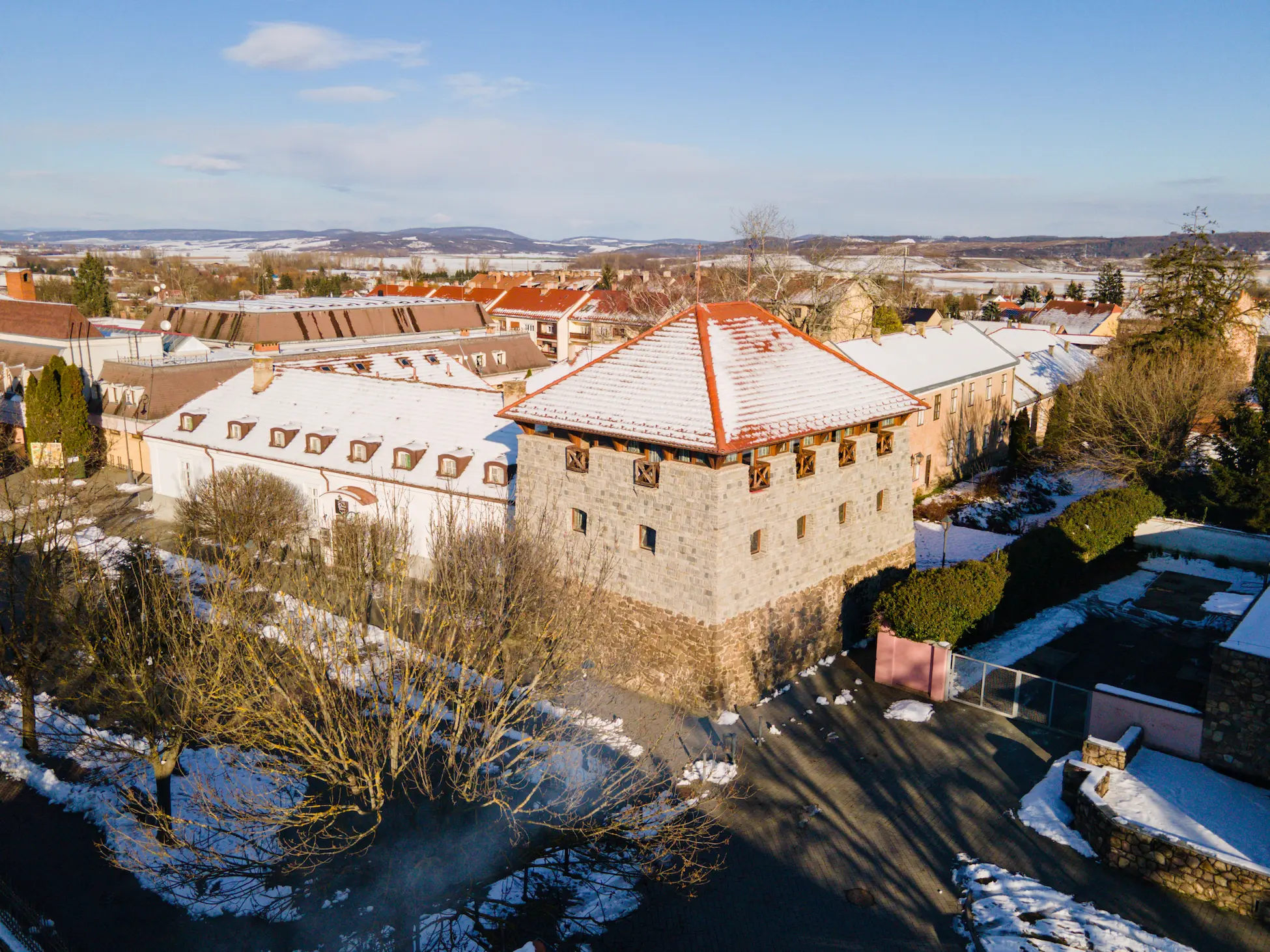
The building complex was most likely developed from the 14th century onwards, as evidenced by the cellar system, which may have originally been either the ground level or the cellar of a medieval residential building. It is located approximately 4 metres below the current pavement level. The complex follows the street layout of early medieval Szécsény, which was later altered during the Baroque period. In Hungary, there are three settlements that historical sources mention as inhabited castles during the Middle Ages: Sopron, Buda and Szécsény. These towns were protected by city walls and fortifications. The rondel was built in the 1600s and originally served as a gate rondel. Later, the Forgách counts living in Szécsény (whose castle can still be visited in the town) had the fourth wall of the three-sided rondel built up, transforming it into the bastion that can still be seen today. At that time, it was used as a granary. The other corner of the building complex was constructed as a district court in 1648. This date can still be seen in a stone frame at the entrance level of the cellar, marking the origin of this part of the building. The prison was located beneath it. An extensive cellar system lies beneath the area, resembling the one found beneath Eger. It served defensive purposes for the town; among other things, ammunition was stored here. Currently, 465 m² of the cellar system is known, although there are still unexplored sections. Szécsény and its surroundings are not a wine-producing region, although the natural conditions would have been suitable for viticulture; the vineyards were completely destroyed during an epidemic that attacked grapevines. However, wine was still needed, which led to the establishment of a wholesale wine business operating in the cellar system until World War II, more precisely until December 1944. At that time, the section between the bastion and the courthouse was damaged by a bomb strike. It lost its former functions and began a period of decline. The bricks and rubble were started to be sold for road construction, but a heritage protection specialist learned about this and immediately stopped the process. By then, only the lower part of the ruins remained, and it was fenced off to prevent unauthorized access. At this point, a local patriot arrived: a 33-year-old young man who saw great potential in the Bastion and the surrounding buildings. He recognised the tourism potential of the region, and his dream was to create a guesthouse. Hollókő is located 15 km south of Szécsény, while the Ipolytarnóc Fossils are 30 km to the north. Szécsény fits perfectly into this cultural axis, with its Gothic church and monastery founded in 1332, the Forgách Castle built in the 1750s–1760s, and the Benczúr Manor House dating back to the 18th century (which was reopened after renovation in December 2023).


The current owner purchased what is now the Bástya Pension in 1988, before the political transition in Hungary. He had photographs from 1938 available, which served as a basis for the historically authentic reconstruction of the building complex. A kitchen, a hospitality area, and 19 guest rooms were created, with the upstairs rooms designed as internal two-level spaces connected by spiral staircases. An interesting detail is that from the 1990s until the 2010s, a famous nightclub operated in the cellar, attracting up to 1,000 visitors on a single evening. Guests arrived not only from Nógrád County but also from Budapest, Szolnok and Eger. As the golden age of the nightclub gradually faded, the cellar system also became underused. At the same time, interest in wellness facilities began to grow, so alongside the renovation works carried out in 2010, plans were also prepared for the creation of a wellness centre, with the aim of utilising the previously unexplored cellar areas. The project was approved by heritage protection authorities and was issued in 2009; however, it can still be renewed and further developed.